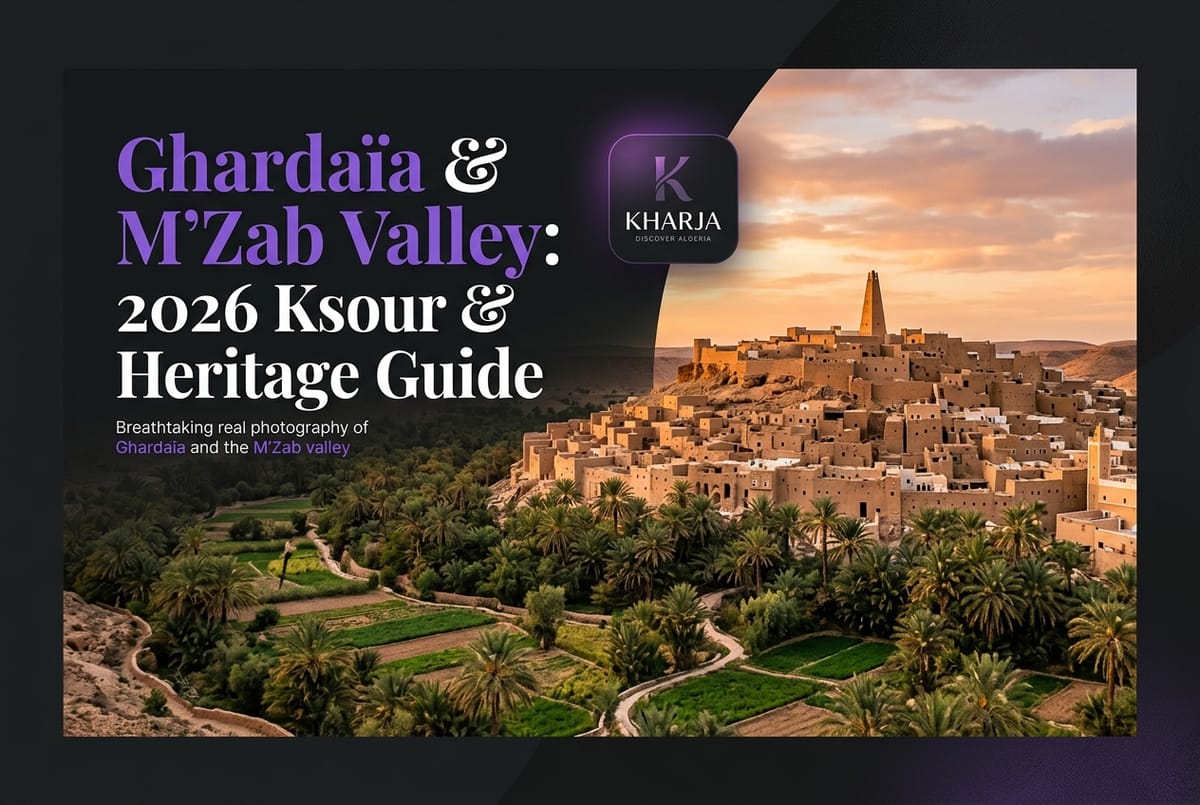
Ghardaïa & the M'Zab Valley: 2026 Ksour & Heritage Guide
Last updated: October 28, 2026
Ghardaïa & the M'Zab Valley: 2026 Ksour & Heritage Guide
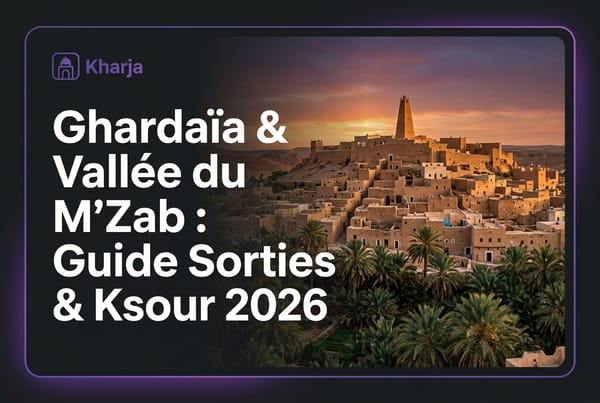
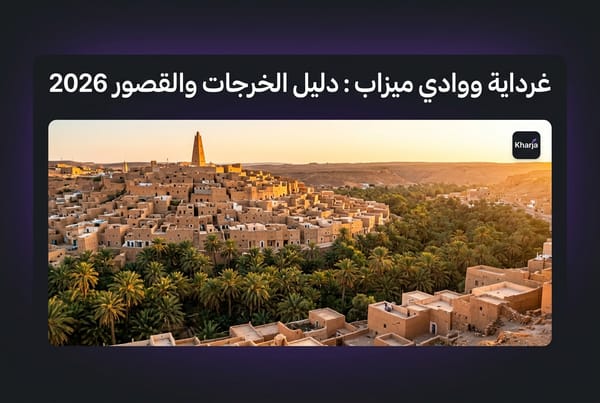
Standing at the northern gateway of the Algerian Sahara, approximately 600 kilometers south of Algiers, the extraordinary M'Zab Valley and its thousand-year-old fortified cities (the Pentapolis) represent one of the world's most astonishing architectural and cultural marvels. Inscribed on the UNESCO World Heritage List since 1982, this arid valley carved by the dry riverbed of the Oued M'Zab showcases a masterpiece of human adaptation where historic mud-brick ksour rise like earthen pyramids against the desert skyline: Ghardaïa, Beni Isguen, El Atteuf, Melika, and Bounoura.
As late October and early November 2026 arrive, the M'Zab Valley enters its most enchanting travel season. The scorching summer heat gives way to wonderfully temperate weather: bright sunny days hovering between 23°C and 26°C (73°F - 79°F) and the invigorating coolness of Saharan starlit evenings. This period coincides with the autumn harvest of succulent Deglet Nour dates in lush oasis groves and the lively atmosphere of traditional souks where world-renowned handmade wool carpets are auctioned daily.
With Kharja, the premier 100% Algerian discovery and event platform, navigate the historic alleyways of the Pentapolis, connect with accredited local guides, and experience authentic Algerian heritage across all 58 wilayas with total peace of mind.
🎯 Key Takeaways
- The M'Zab Valley encompasses five medieval fortified hill towns (ksour) founded between 1012 and 1053, designated as a UNESCO World Heritage site for their harmonious urban design and living communal heritage.
- The vernacular Mozabite architecture, characterized by its organic sculptural curves and minimalist purity, directly inspired modern masters including renowned architect Le Corbusier.
- Late October through March provides the perfect climate for exploring the historic ksour, green palm oases, and artisan auction markets.
- Visiting the holy town of Beni Isguen and its afternoon open-air auction market (Souk Lalla Aouda) offers an unforgettable cultural journey into timeless trade traditions.
- The ancestral hydraulic water-sharing system and stone dams in the M'Zab palm groves stand as a testament to medieval ecological engineering in hyper-arid zones.
- The Kharja mobile app enables travelers to discover verified walking circuits, book traditional guesthouses, and access genuine reviews from local explorers.
📋 Table of Contents
- The Pentapolis of M'Zab: Five Legendary Fortified Cities
- Beni Isguen and the Lalla Aouda Auction Market: Living Heritage
- Bioclimatic Architecture and the El Atteuf Mosque: Le Corbusier's Muse
- Hydraulic Mastery in the Palm Groves: The Ancient Water Comb System
- Staying in a Traditional Palm Grove Guesthouse: Mozabite Hospitality
- Comparative Table of Tours and Circuits in the M'Zab Valley
- Practical Travel Tips and Local Customs for Your Visit
- Frequently Asked Questions About Ghardaïa and M'Zab
The Pentapolis of M'Zab: Five Legendary Fortified Cities {#the-pentapolis-of-mzab-five-legendary-fortified-cities}
The Pentapolis of the M'Zab Valley consists of five fortified medieval settlements perched atop rocky hills, each crowned by a distinctive tapering minaret functioning as a watchtower.
Established in the eleventh century by the Ibadi community seeking refuge in the barren limestone plateau of the Chebka, the valley unites five distinct cities situated within a few kilometers of each other: El Atteuf (the oldest, founded in 1012), Bounoura (1046), Ghardaïa (the commercial capital and administrative hub, founded in 1048), Beni Isguen (the holy town of scholars, 1050), and Melika (the queenly panoramic city, 1053). Later centuries saw the establishment of neighboring satellite towns Guerrara and Berriane.
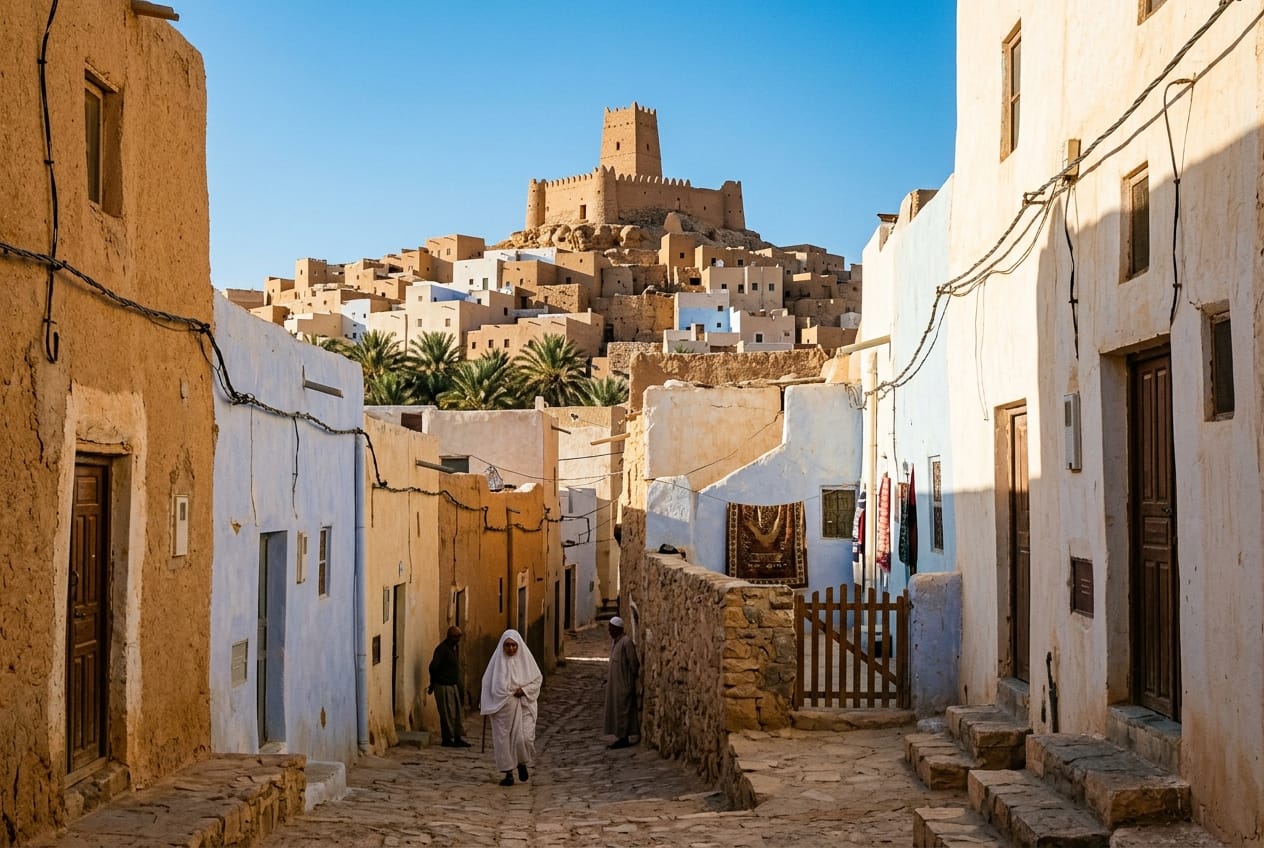
Each ksar forms a strictly organized concentric urban pattern. Built from local limestone, clay mortar, and plaster washed with white lime, ochre, and pale blue, the flat-roofed houses cascade down the slopes from the central mosque at the summit. This defensive design guaranteed equal access to sunlight and strict family privacy while deterring desert invaders. Strolling through the vibrant arcaded market square of Ghardaïa introduces visitors to centuries of trans-Saharan caravan exchange between nomadic traders and skilled urban artisans. For travelers eager to explore more of Algeria's past, discover our comprehensive guide to cultural outings and archaeological sites in Algeria.
Beni Isguen and the Lalla Aouda Auction Market: Living Heritage {#beni-isguen-and-the-lalla-aouda-auction-market}
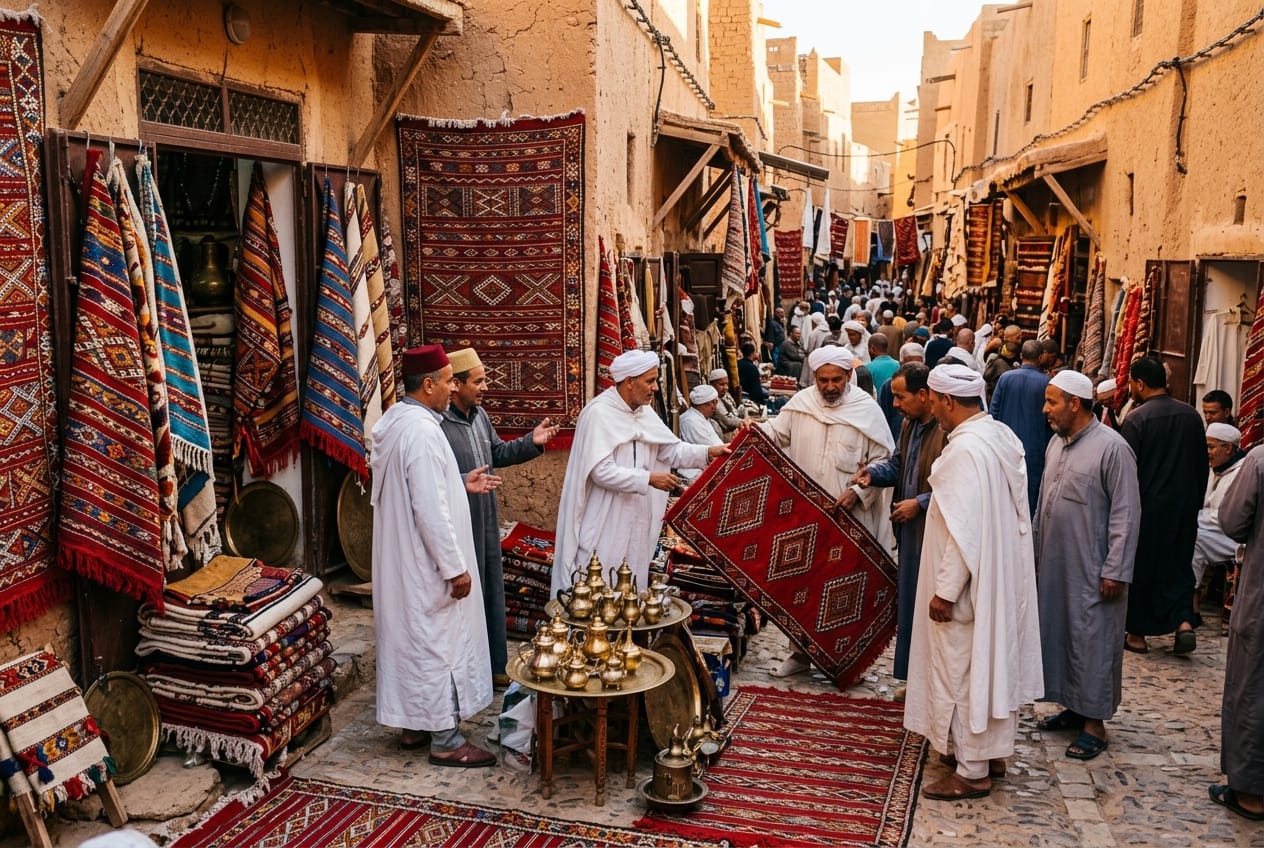
The afternoon auction market of Souk Lalla Aouda in Beni Isguen continues an ancient public bidding tradition where handmade Berber wool rugs and antique brassware are sold daily.
Known as the spiritual heart and guardian of regional customs, Beni Isguen remains completely encircled by high defensive ramparts with heavy wooden gates. Crowning the town is the monumental Tour Boulila, a twelfth-century cylindrical watchtower providing an awe-inspiring 360-degree vista over labyrinthine rooftops and the sweeping emerald canopy of date palms. Walking through the spotless, hushed lanes of Beni Isguen feels like stepping centuries back in time: silence reigns, shaded arches offer cool relief from the sun, and heavy cedar doors boast intricate hand-carved wooden locks.
Every late afternoon, roughly two hours before the sunset prayer (Maghrib), the triangular stone square of Souk Lalla Aouda comes alive for the traditional open-air auction (Lezzem). Licensed auctioneers walk through the circle of seated elders and merchants, carrying across their shoulders magnificent handwoven sheep's wool carpets, traditional camel hair burnous cloaks, hand-hammered brass teapots, and antique silver jewelry. No permanent commercial signs or storefronts exist on the plaza; every sale is conducted with integrity under customary civic codes established during the Middle Ages. This authentic spectacle mirrors the legendary desert trade caravans explored in our guide to Taghit and the Saoura oasis in western Algeria.
Bioclimatic Architecture and the El Atteuf Mosque: Le Corbusier's Muse {#bioclimatic-architecture-and-the-el-atteuf-mosque}
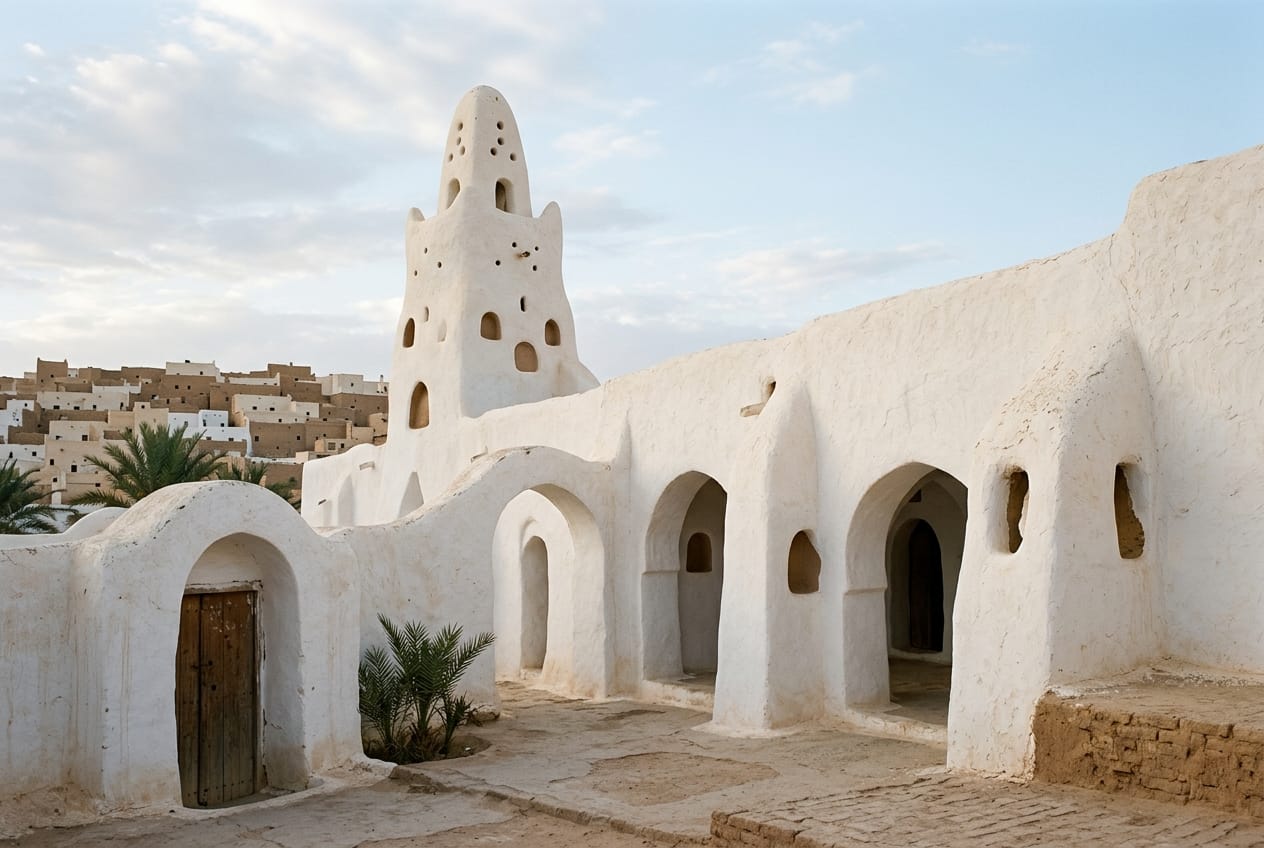
The vernacular architecture of El Atteuf and the M'Zab showcases organic forms and passive bioclimatic principles that revolutionized the philosophy of leading twentieth-century architects.
The earliest settlement founded in the valley in 1012, El Atteuf ("the bend," so named because the dry valley curves here) shelters the celebrated funerary mosque of Sidi Brahim below its ramparts. This breathtaking sanctuary features sweeping whitewashed horseshoe arches, prayer niches carved directly into the lime plaster, and asymmetrical wall openings that filter soft celestial light into the earthen prayer hall. When Swiss-French master architect Charles-Édouard Jeanneret, known as Le Corbusier, visited in 1931, he was profoundly moved by its sculpted, human-scaled proportions; the organic curves of Sidi Brahim directly inspired his design for the world-famous Chapel of Notre-Dame-du-Haut in Ronchamp, France.
Beyond its artistic elegance, Mozabite residential architecture serves as an exemplary prototype of passive bioclimatic design. Thick limestone and adobe walls provide significant thermal mass, absorbing the desert chill overnight and releasing it slowly during warm autumn days. In the center of every home, a vertical opening called the chems acts as a natural ventilation chimney, drawing warm air upward and drawing in cooler air from ground-level courtyard spaces. This historic ingenuity echoes the timeless architectural heritage seen in our guide to Constantine's bridges and historical sites.
Hydraulic Mastery in the Palm Groves: The Ancient Water Comb System {#hydraulic-mastery-in-the-palm-groves}
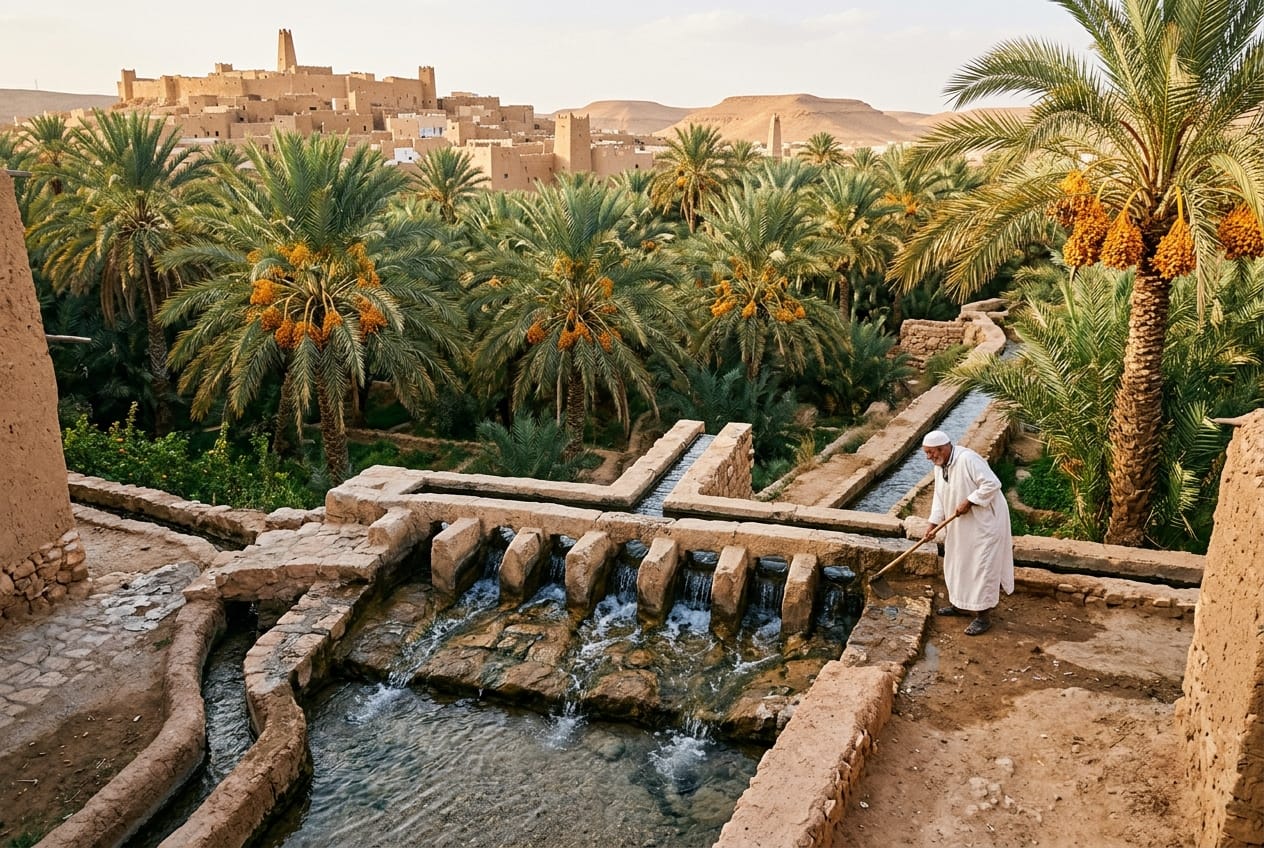
The lush palm groves of the M'Zab Valley flourish through an ingenious hydraulic system of stone dams and distribution combs designed to capture and share flash-flood waters.
In a region where annual precipitation rarely exceeds 100 millimeters, the founders of the M'Zab accomplished the agricultural feat of nurturing an oasis boasting over two hundred thousand date palm trees. When sudden autumn thunderstorms hit the barren Chebka plateau, the dry riverbed turns into a powerful torrent. Immediately, a sophisticated network of stone retaining dams (ahbass) and stone dividing weir combs known as the water distribution comb (oumana el ma) springs into action.
These precisely calibrated stone dividers partition the flowing water into smaller irrigation channels (seguias) strictly proportional to the surface area of each family's orchard plot, ensuring absolute equitable access without consuming fossil fuel or modern energy. Beneath the towering date palms, farmers cultivate a traditional three-tiered oasis ecosystem: tall palms on the top level protecting orange, pomegranate, and fig trees below, while fresh alfalfa, mint, and seasonal vegetables thrive on the shaded ground. A peaceful walk through the palm groves in autumn is an unforgettable nature outing, complementing our recommendations for hiking and nature excursions in Algeria.
Staying in a Traditional Palm Grove Guesthouse: Mozabite Hospitality {#staying-in-a-traditional-palm-grove-guesthouse}
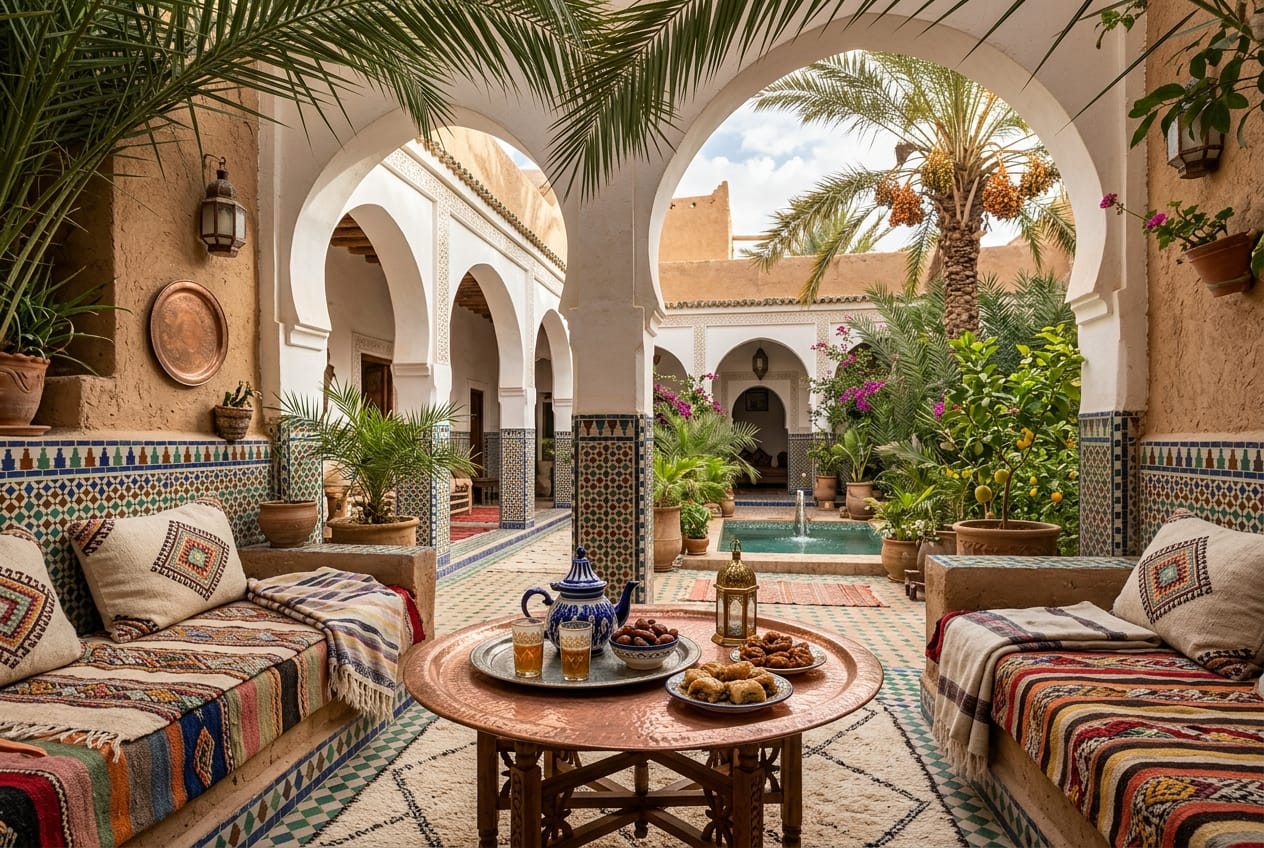
Lodging in a restored traditional guesthouse nestled within the date palm grove offers an intimate glimpse into Saharan culture, serene courtyard gardens, and exquisite local cuisine.
To truly immerse yourself in the spirit of the valley, booking a room in a restored Mozabite oasis residence (maison d'hôtes) is the preferred choice for discerning travelers. Tucked away within the palm orchards just outside the ksar walls, these guesthouses center around shaded courtyards filled with citrus trees, fresh mint beds, and tranquil stone reflection pools. Rooms are decorated with local palm-wood beams, terracotta floors, and hand-embroidered textiles created by women's cooperatives in Beni Isguen.
Evenings in the guesthouse bring authentic regional dining to the table:
- Couscous with sweet dates and tender vegetables, paired with slow-cooked meat infused with mild Saharan spices.
- Traditional southern Rfissa, finely shredded warm flatbread smothered in an aromatic herb-infused broth and clarified butter.
- Freshly harvested Deglet Nour dates, renowned for their translucent golden hue and honeyed taste, served alongside fresh camel or goat milk.
- Fresh mint tea brewed over glowing coals, served with almond-filled gazelle horns and semolina pastries.
This genuine warmth mirrors the memorable desert bivouac experiences highlighted in our guide to Djanet and the Tassili n'Ajjer Sahara, illustrating the rich diversity of Algeria's southern territories.
Comparative Table of Tours and Circuits in the M'Zab Valley {#comparative-table-of-tours-and-circuits-in-mzab-valley}
To help plan your itinerary across the 47th wilaya of Algeria, review this comparative breakdown of premier circuits, recommended durations, and indicative pricing in Algerian Dinars (DZD):
| Circuit / Attraction | Key Highlights | Recommended Duration | Difficulty Level | Indicative Budget (DZD) | Best Time of Day |
|---|---|---|---|---|---|
| Ghardaïa Ksar & Central Market | Historic market square, tapering minaret, medieval alleys, spice souk | Half-day (3-4 hours) | Easy (paved streets) | 2,500 – 4,000 DZD (Guide) | Morning (08:30 - 12:00) |
| Beni Isguen & Tour Boulila | Defensive walls, Boulila tower panorama, peaceful lanes, Lalla Aouda auction | Half-day (3 hours) | Moderate (steps to tower) | 2,500 – 4,500 DZD (Mandatory guide) | Late afternoon (15:30 - 18:00) |
| El Atteuf & Sidi Brahim Mosque | Sidi Brahim sanctuary (Le Corbusier's muse), first cemetery, old ksar | 2 to 3 hours | Easy | 2,000 – 3,500 DZD | Early morning (soft light) |
| Palm Grove & Water Divider System | Stone distribution combs, historic dams, foggaras, date harvest orchards | Half-day (3 hours) | Easy (flat paths) | 2,000 – 3,000 DZD | Late afternoon (cool air) |
| Full Pentapolis Circuit (3 Days) | All 5 ksour, palm grove immersion, artisan workshops, Melika sunset | 3 full days | All traveler types | 25,000 – 45,000 DZD (Accommodation incl.) | October through late March |
Practical Travel Tips and Local Customs for Your Visit {#practical-travel-tips-and-local-customs-for-your-visit}
Ensuring a memorable stay in the M'Zab Valley involves thoughtful logistical planning and respectful adherence to customary local etiquette.
How to Reach Ghardaïa
Travel connections to Ghardaïa are reliable and accessible:
- By Air: Ghardaïa – Noumérat - Moufdi Zakaria Airport (GHA) operates several regular domestic flights per week from Algiers via Air Algérie and Tassili Airlines (flight time approx. 1h15m). Direct and connecting routes also run from Oran and Constantine.
- By Road: National Route 1 (RN1), a major modernized dual-carriageway highway connecting north to south, leads from Algiers to Ghardaïa in about 7 to 8 hours by car via Blida, Médéa, and Djelfa.
- By Coach: Several reputable long-distance bus operators run daily overnight and express services between Algiers and Ghardaïa.
Golden Rules for Respecting Local Traditions
Mozabite society takes deep pride in its centuries-old religious and civic traditions:
- Engage an Accredited Local Guide: In fortified ksour—particularly Beni Isguen and El Atteuf—independent wandering without a licensed local guide registered with the Office for the Protection and Promotion of the M'Zab Valley (OPVM) is not permitted. These guides offer valuable insights into local history and customs.
- Dress Modestly: Both men and women must dress conservatively, ensuring shoulders, upper arms, and knees are fully covered. Sleeveless shirts, short shorts, and form-fitting outfits should be avoided.
- Photography and Discretion: Never photograph local residents without their explicit prior permission, particularly women wearing the traditional white haïk mantle. Smoking and loud behavior inside sacred ksar boundaries are strictly prohibited.
- Opening Hours: Beni Isguen closes its gates to outside visitors at sunset. Schedule your afternoon arrival around 15:30 to experience the Lalla Aouda auction before gates close.
For direct contact with verified guides, traditional guesthouse bookings, and interactive GPS maps across all 58 wilayas, download the Kharja mobile app!
{{APP_BADGES}}
About Kharja
Kharja (خارجة) is Algeria's leading 100% homegrown technological platform dedicated to discovering, organizing, and booking leisure outings, tours, and events across all 58 wilayas. Created by passionate advocates of local tourism and digital innovation, Kharja connects families, trekkers, and cultural enthusiasts with certified local guides and premier event organizers nationwide.
Follow our journey and discover new Algerian treasures each week:
- Official Website: kharja.life
- Web Application: app.kharja.life
- Instagram: @kharja_life
- Facebook: Kharja خرجة
- X (Twitter): @kharja_life
- TikTok: @kharja_life
- YouTube: @Kharja_life
Frequently Asked Questions About Ghardaïa and M'Zab {#frequently-asked-questions-about-ghardaia-and-mzab}
When is the best time to visit Ghardaïa and the M'Zab Valley?
The prime season to travel to Ghardaïa is between late October and late March. Autumn and winter bring pleasant daytime temperatures (20°C to 25°C / 68°F to 77°F), clear blue skies, and the fresh date harvest season in the palm groves. Avoid mid-summer (July and August) when extreme temperatures regularly exceed 45°C (113°F).
Is a local guide mandatory when visiting the M'Zab ksour?
Yes, for several ksour—most notably Beni Isguen and El Atteuf—visitors are required to tour with an accredited local guide certified by the OPVM. This policy safeguards community privacy and preserves centuries-old heritage while providing travelers with rich architectural and cultural interpretations. Certified guides can be booked directly through the Kharja app.
How many days should I spend in Ghardaïa?
A 3 to 4-day stay is recommended to experience the Pentapolis thoroughly without rushing. This timeline allows one day to explore Ghardaïa and Melika, one day dedicated to Beni Isguen, its palm grove, and the afternoon auction, one day for El Atteuf and Bounoura, and leisure time to browse authentic carpet workshops and relax in a tranquil guesthouse patio.
Can travelers purchase genuine M'Zab carpets locally, and what are the prices?
Yes, Ghardaïa and Beni Isguen are internationally celebrated for their handmade pure virgin wool carpets crafted on traditional wooden looms by Mozabite artisans. Featuring distinct geometric Berber symbols, prices typically range from 15,000 DZD for smaller decorative bedside rugs up to 60,000 DZD or more for large living room masterworks, depending on density and craftsmanship.
What should visitors wear and how should they behave inside the ksour?
Visitors should wear respectful, modest clothing that covers shoulders, chest, and knees. Avoid form-fitting garments. Never photograph local residents—especially women in their traditional white haïk—without consent. Smoking and consuming alcohol are prohibited inside the ancient fortified towns.